
In the wellness world, “immune support” is one of the most overused phrases—and one of the least carefully explained. The problem is not that people care about immunity. The problem is that immunity is often treated like a volume knob: turn it up and you’ll be safer.
Biology doesn’t work that way.
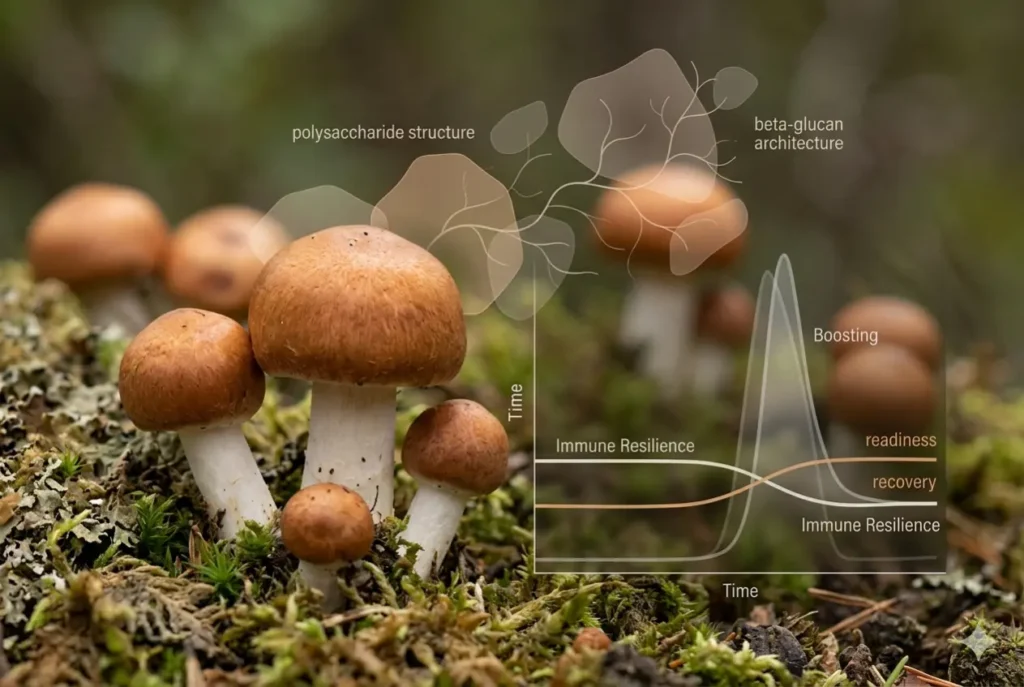
A resilient immune system is not permanently “high.” It is responsive, proportionate, and capable of returning to baseline. That’s why we often use the term immune resilience rather than “boosting.” Resilience is about readiness and recovery—how the system behaves over time.
What are mushroom polysaccharides, really?
In mushrooms, one of the most studied families of compounds is polysaccharides, including beta-glucans. These are large carbohydrate molecules—structural by nature, information-rich in their patterns, and diverse in how they are branched and linked.
Beta-glucans are not one single substance. Their properties depend on:
- linkage patterns (e.g., β-(1→3), β-(1→6))
- degree of branching
- molecular weight distribution
- extraction and purification methods
That complexity matters because it determines how these molecules interact with biological systems. A general structural overview can help readers understand why “beta-glucan” is not a uniform label.
ABM as a polysaccharide-rich mushroom
Agaricus blazei Murill (ABM) has been studied for decades, and multiple reviews emphasize that polysaccharides are a major component of interest—often alongside other constituents such as sterols and phenolics.
Specific studies have isolated and structurally characterized beta-glucans from ABM fruiting bodies, examining their chemical features and describing procedures for extraction and analysis.
From a Desert Forest perspective, the value of discussing these studies is not to promise outcomes. The value is to show readers that ABM is not a vague folkloric ingredient—it’s a biologically definable material with identifiable molecular families that can be studied with modern tools.
The immune system “touchpoints”: interaction, not guaranteed outcomes
In immunology, beta-glucans are often discussed in relation to immune cell receptors and signaling pathways. But translating “interaction” into consumer language is where many brands go off the rails.
A scientifically honest statement looks like this:
- Mushroom polysaccharides are researched for their capacity to interact with immune pathways.
- That research includes in vitro work, animal models, and some human studies depending on the mushroom.
- The strength of evidence differs by compound, preparation, dose, and study design.
- Therefore: it is reasonable to discuss mechanisms and research interest, but irresponsible to imply diagnosis, treatment, cure, or guaranteed prevention.
This is exactly why we keep our framing centered on supporting normal physiology and resilience, not on medical claims.
Where vitamin D belongs in this picture
Vitamin D and polysaccharides can both show up in conversations about immunity, but they are chemically and biologically different categories:
- Vitamin D: a fat-soluble hormone-like nutrient that functions through receptor-mediated gene regulation; linked strongly to bone and calcium metabolism and more broadly to immune regulation in mechanistic literature
- Polysaccharides (beta-glucans): large structural molecules with diverse architectures, researched for immune pathway interaction and functional food relevance
When brands blur these categories, readers end up with a foggy “everything supports immunity” message. The better approach is to separate them clearly, then explain how each belongs in a sensible foundation strategy.
The foundation strategy: clarity beats excitement
A practical “immune resilience” strategy begins with fundamentals:
- sleep, stress management, movement
- adequate protein and micronutrients
- correcting clear deficiencies (vitamin D if relevant)
- consistent, food-first habits
Within that foundation, ABM can be discussed as:
- a mushroom with a studied polysaccharide profile
- a material with a long history of attention in Japan and elsewhere
- a candidate for ongoing research interest, especially when preparations are well-characterized
Next week (final post), we’ll bring the series together: vitamin D importance, mushrooms and D2, ABM’s two-layer composition (sterols/potential D2 pathway + polysaccharides), and how to communicate these topics responsibly—with a brief but necessary note on safety.
Bibliography
- Polysaccharides and extracts from Agaricus brasiliensis (ABM) – A review (2021). (ScienceDirect)
- Critical review on chemical compositions… of Agaricus blazei Murrill (2022). (ScienceDirect)
- Structural characterization of β-glucans isolated from Agaricus blazei… (Food Bioscience, 2013). (ScienceDirect)
- β-Glucan comparison in medicinal fungal species (2024). (sciencebiology.org)
- An Update on the Effects of Vitamin D on the Immune System… (IJMS, 2022). (mdpi.com)